'Modi has visited all these three countries (the UAE more than once, inexplicably) but has left out Kuwait and Oman, the two Gulf countries that are closest to India in their political, cultural and civilisational ethos,' notes Ambassador M K Bhadrakumar.

'In India foreign policy is generally handled by the prime minister.' 'One can clearly see the Vajpayee stamp on all this.' 'Only a person with poetic imagination can weave such a complex web,' says Colonel Anil A Athale (retd).

Although sectarianism is very common in Pakistan but these days, Balochistan province is much under the influence of this menace where people from Sunni and Shia sects are targetting each other.

Saudi Arabia on Sunday came under attack globally a day after it carried out mass execution of 47 people, including Shia cleric Sheikh Nimr al-Nimr who was a vocal critic of the government and the Saudi monarchy.
Given all the turbulence created by Pakistan Foreign Minister Qureshi's unexpected tirade against Saudi Arabia, it is likely to be business as usual between the two countries, albeit with a bit of caution on the part of both, observes Lieutenant General Syed Ata Hasnain (retd).
A Shia leader who was the main target of the suicide bomber was not in office when the blast occurred.
On Thursday, maximum new cases were recorded in Balochistan where the number of infected people rose to 76 from 23. Punjab was the next where the number rose from 33 to 78, Dawn reported.
Dr Andrew McGregor, director, Aberfoyle International Security, Toronto and senior editor, Jamestown Foundation Global Terrorism Analysis Program, Washington DC, says that further military intervention by the US in Iraq is a non-starter.

How long can Pakistan remain neutral in the Saudi Arabia-led Yemen conflict?
At least three people were killed and nine others injured when a suspected suicide bomber targeted a bus carrying Shia pilgrims in Balochistan province of southwest Pakistan on Tuesday, according to officials.

Unless the Taliban goofs up in a big way, which seems highly unlikely, we are looking at a regime that will be around for quite a long while and present a level of governance that the puppets of the richest and most advanced countries failed to provide, predicts Ambassador M K Bhadrakumar.
While the United States deals with India as an Indian Ocean and Pacific Ocean power, it deals with Pakistan and countries to the West as part of Middle East, says Col Anil Athale.

Pakistan said on Monday that its close ally Saudi Arabia has asked for ground troops, warships and fighter planes to oust the Shia rebels in war-torn Yemen as lawmakers debate whether the country should join the conflict which has sectarian and domestic implications.

Rouhani said people who think Islam is a religion of "violence and terrorism" are wrong in their assessment.

Pakistan Prime Minister Nawaz Sharif is in Turkey on a day-long official visit to hold discussions with the country's top leadership on the Yemen crisis.

But it is less adventurous. It seems, at last, that in its eighth decade, Pakistan has settled into being a parliamentary democracy just like Bangladesh has and like we have always been, observes Aakar Patel.

India is apprehensive about the Taliban's return as it would mean loss of access to Baluch rebels and help to the restive tribals of Waziristan. This would be a setback to the Indian strategy of returning the compliments of death by a thousand cuts to Pakistan, notes Colonel Anil A Athale (retd).

The Taliban have the ISIS in its crosshairs. The Taliban has shown the skill to assimilate extremist elements if they are reconcilable as well as the ruthlessness to eliminate troublemakers, observes Ambassador M K Bhadrakumar

The New York Times reported that according to Rushdie's agent, Andrew Wylie, the Mumbai-born controversial author was on a ventilator and could not speak.

Once Mazar-i-Sharif falls, some isolate pockets of resistance may remain, which the Taliban would tackle through political work or coercion, asserts Ambassador M K Bhadrakumar.

Pompeo defended the killing of Soleimani saying he was making efforts for an attack on Americans in the region.
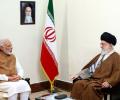
Prime Minister Narendra Modi on Monday called on Iranian Supreme Leader Ali Khamenei.

The alacrity with which regional States responded to Delhi's invite signals that expectations are high regarding an Indian role in the efforts to stabilise the situation in Afghanistan, observes Ambassador M K Bhadrakumar.

Talmiz Ahmad is a former Indian ambassador to Saudi Arabia, Oman and the UAE. In an interview with Aditi Phadnis, he says the disequilibrium in Iraq will continue to prevail. Ahmad also says there are indications that the US is now anxious to avoid intervening militarily in West Asia, and that this is the appropriate moment for Asia to assume responsibility for its own security. Edited excerpts:
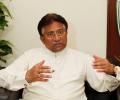
Learning perhaps from the Kargil debacle, Musharraf tried hard to evolve as a statesman in his dealings with India, recalls Rana Banerji, who headed the Pakistan desk at RA&W.
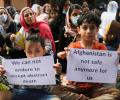
For Afghans in India, including medical tourists from the war-torn country as well as migrants and refugees staying here much longer, the safety of friends and families is the biggest concern - particularly for those linked to the now collapsed government or who have had work ties with the US.

'Mr Trump is too capricious to be trusted,' says Sunanda K Datta-Ray.

A beautiful documentary from Delhi. A shocking satire that spares no one. A thriller about a serial killer in Iran. A Pakistan film about family secrets... Aseem Chhabra lists the best films he saw in Cannes.
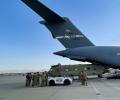
Remember the US withdrawal agreement was signed in February 2020. In the intervening period, a proper evacuation plan ought to have been in place. It was not. Consequently, tens of thousands of Afghans who had worked as interpreters, drivers, suppliers of goods and services, etc, face brutal retribution from the Taliban, Virendra Kapoor points out.

The Saudi-Pakistan nuclear weapons cooperation is meant to sound alarm bells in Washington, reminding the Obama administration that its overtures to Iran would have serious negative consequences in terms of its ties with its closest allies in the region, says Ambassador Talmiz Ahmad. Exclusive to Rediff.com

ISIS' advances in Iraq and Syria are not just tactical but strategic victories -- born of US errors and confusion

'The blasts destroyed my family. Two of my sons are in jail and one is absconding.'
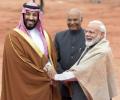
'The more emphatic denial of any proposal for an OIC foreign ministers meet in Islamabad appears aimed at keeping Pakistan on a leash,' notes Lieutenant General Syed Ata Hasnain (retd).

Specially designated global terrorist Sirajuddin Haqqani, who carries a reward of $10 million US bounty on his head, is the acting interior minister while his uncle -- Khalil Haqqani -- has been named as acting minister for refugees.

'The stage is set for increasing tensions in a highly volatile region as crucial as ever from a geopolitical standpoint,' predicts Claude Smadja.
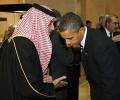
Further deterioration of the US-Saudi relationship will have geo-economic and geopolitical effects, says Nitin Pai.

'A 2018 murder may lead to shifts in the geopolitical order and impact at least one monarchy,' says Devangshu Datta.

Nawaz Sharif will lead a high-level delegation to Saudi Arabia in a bid to cool tempers in the kingdom over Islamabad's refusal to provide troops for the war in Yemen.

Volkswagen mess costs Germany its strongest nation brand position.

Congress leaders in the upper house called CAB unconstitutional, 'arbitrary executive fiat' to push Hindutva agenda.
